|
The
Story of Bobcat Twister
by Alan Rogers
Outside of the small town of Deer Trail, Colorado is a sign that claims the
nation's first rodeo was held there in 1869. It's easy to imagine the
cowboys and livestock of that day and what it all looked and sounded like.
But I wonder if any of the performers were like Bobcat Twister.
He was part Longhorn and part Brahman. Born in 1923 in Louisiana, he is said
to have killed a young man in 1926. Somehow, he made his way to the Kansas
Flint Hills where he was found by Monte Reger of Buffalo, Oklahoma. Reger
and his father-in-law, George Crouch, were rodeo people and established the
famed rodeos at Doby Springs, Oklahoma in the 1920's. Monte traveled to
Kansas in search of rodeo stock and purchased several head. Among this bunch
of cattle was a stand-out steer -- the one with terrific horns. As it
happened, there was room on the railcar for one more head, and the fancy
steer was on his way to celebrity. Somewhere in his life, the steer lost the
lower portion of his tail. Because of this feature, and along with his high
twisted horns, he was named Bobcat Twister. Monte trained him to pull carts,
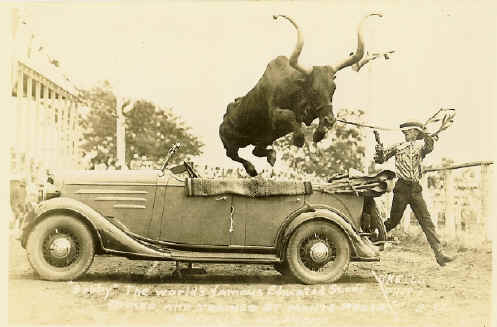
to be ridden, and to jump. He was highly skilled at jumping. So much so that
he easily jumped over a 1930's Chevrolet convertible, which he did for many
attendees at rodeos and public performances, including Madison Square Garden
in New York. In the 1990's, I spoke to Monte's widow, Opal, a pleasant lady
who recalled selling postcard pictures of Bobcat Twister for a nickel. She
died in 1998 at age 92.
Being a collector of old steer horns since 1972, I like to study early
pictures of horned cattle. I have dozens in my collection. They have been my
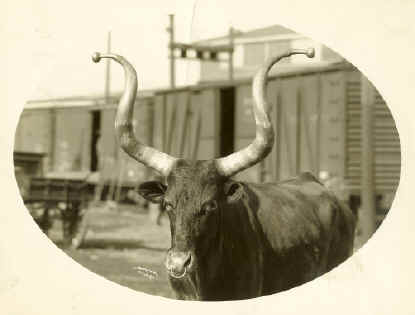
schoolroom. Evidence of the steer's Brahman bloodline is the shape of his
poll section and its shorter hair. Also, notice the acute angle at which the
horns first leave his head, which accounts for this unusually high horn. In
addition, we find an elongated-type ear, common to the Brahman, without the
long hair so commonly found on early Texas cattle. He was narrow framed,
having a high ground clearance at the belly. Typical of his Longhorn
ancestry are his generously twisted horns. Now almost lost in horn
discussions is the old term "lyre-shaped," so named after the ancient
stringed instrument. Decades ago, this term was used when referring to horn
shapes of cattle painted on the walls of Egyptian tombs. Bobcat Twister is a
classic example of the lyre-shaped horn. An elderly Texas rancher with whom
I became well acquainted tells me that among the most beautifully shaped
horns he saw as a young man were those on Longhorn-Brahman crossed steers.
Bobby, as he was often called, died
in 1942, and his head was mounted. At last report, he was still in the
Reger family. Like any form of entertainment, the American rodeo circuit
has its own stars and celebrities. All things considered, it might be a
while before we see another star quite like Bobcat Twister.
Copyright: Alan
Rogers |
.jpg)