|
Horn Gallery - Page 1
At
least as early as the 1893 World's Fair in Chicago, horns over six feet wide have been
imported from Africa, Bolivia, Brazil and Argentina. It has become a real challenge to
know the difference between imports and old Texans. |
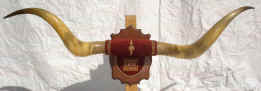
Dated 1874
4 ft. 4 in. across,
10 1/4 in. base
An older steer probably alive when
Lincoln was president.
|
Drilled for the Hollow Horn
These 1874 steer horns were driven up the Trail, probably to a Kansas cowtown, and taken
by rail to Chicago and killed there. Some herds were also driven to Ogallala, Nebraska and
the Union Pacific Railroad in 1874.
An historical
feature of these is that they were drilled for the "hollow horn," a practice
most often used by Mexican ranchers in Texas. A small pencil-size hole was sometimes
drilled on the bottom side of a horn to drain blood. Bloodletting was thought to improve
the health of an animal believed to be doing poorly. |
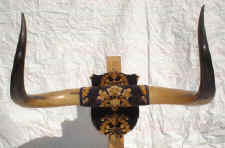
The color of horn tips adds to their beauty. Very often they are black, dark brown and
sometimes caramel colored. Cowboys on trail drives have recounted stories that during rain
storms at night, they had seen lightning jumping off the tips of horns.
|
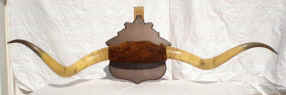
Early Texas Steer of the purest type.
Still attached to his own poll section. Slender and black-tipped.
Latter 1880's
5 ft. 2 in., tip to tip
In collecting old horns,
the more shape, the better! |
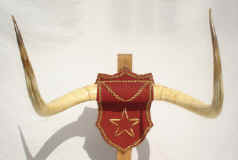
A better than average set of the
forward and up growth pattern. 1920's steer. |
Tens
of thousands Longhorns were shipped by rail to the Eastern Seaboard prior to 1900. One of
the early and large-scale makers of horn furniture, horn novelties and mounted sets of
steer horns was the P. F. Lane Company of Leominster, Massachusetts. They're known to have
operated from at least 1884 into 1905. I've seen many sets of their mounted steer horns,
and virtually all of them were mounted in red fabric accompanied with a hoof. |
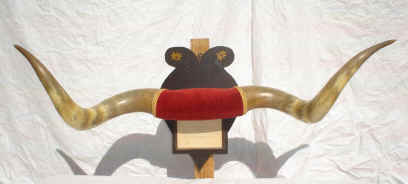
Dodge City
43 inches, tip to tip
These horns are from a steer used as a team to pull the freight wagons of Harry Tobias, a
bull-whacker
who operated along the military road from Dodge City to Camp Supply (Indian Territory,
Okla.) and
Camp Mobeetie in Texas in the 1870's.
Harry Tobias born in Ohio, 1856. Died of the quick consumption in
Dodge City, 1917.
|
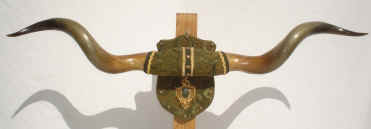
Fancy Twisted Cow Horns
Dating to about 1900.
41 inches wide & having a base circumference of about 8 1/2 inches, a common base size
for early Texas cows.
Texas Longhorn cattle are descendants of Spanish stock.
These Spanish-type cattle arrived in North America in 1521. The first Spanish cattle to
enter what became the United States was in 1540, about 500 head brought by the explorer
Coronado as a supply of food for his expedition into the southwest U.S. Probably the
first Spanish cattle to enter what is now Texas came in 1690 with the establishment of a
mission near the Louisiana border.
|
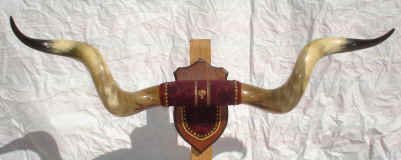
Superior Example of the Corkscrew
Twist
Steer of the 1880's. Probably born in the early 1870's.
41 inches wide.
An uncommon shape in early Texas
steers! |
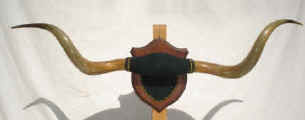
Slender, Shapely Horns.
Over 4 feet.
A steer well into his teen years.
To study old photos of early day cowboys, it would appear that nearly all of them were
white but, actually, about 1/3 of all cowhands that went up the trail were blacks and
Mexicans. |
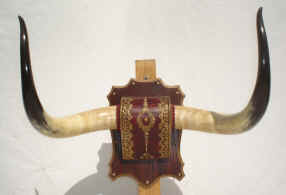
Impressive Long Black Tips.
Elegant mount by Alan Rogers. |
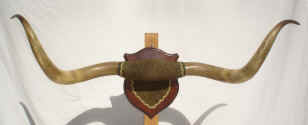
Early 1900's Steer
A slender build and backward curl.
About 4 1/2 feet.
Associated with the
Old West, the term Green Horn generally referred to a person who was young or
inexperienced in his craft or trade. It originated with cowboys who noticed the horns on
young cattle had a greenish tint. |
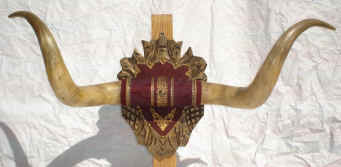
Up the Trail Horns - Late
1860's-'70's
34 1/4 inches wide. Tens of thousands of Texas steers in early trail drives carried horns
like these. Stories abound about giant steer horns coming up the Trail, but they're not
true. The old sets of horns in collections and early photos of Longhorn cattle say
otherwise. Naturally, there would have been some cattle that had noticeably wider horns
than the average. But remembering that most steers were shipped to market at 3 to 4 years
of age, we know they had not yet produced the big trophy sets. Time alone will not produce
wide sets of horns. The genetics must be there, also. In the nearly 400 sets of old horns
I have owned, only five sets pre-dated 1875. The largest of them was 5 ft. 4 inches. All
of the others were under 4 1/2 feet. If we could go back in time to a Kansas cowtown
in the early 1870's, we would probably not be impressed with the steer horns we saw. The
term "Longhorns" is relative. Compared to the shorter horns of other breeds of
cattle in the country during this period, a 3 or 4 foot set of Texas horns would have
looked huge to most people. So the very name of the cattle -- Texas Longhorns --
could be a little misleading. We certainly know that the wild stories of seven, eight or
nine foot horns coming up the trail by the hundreds are not true. I don't know of one set
of horns over six feet wide that pre-date 1880.
|
The Horns of Johney the
Ghost
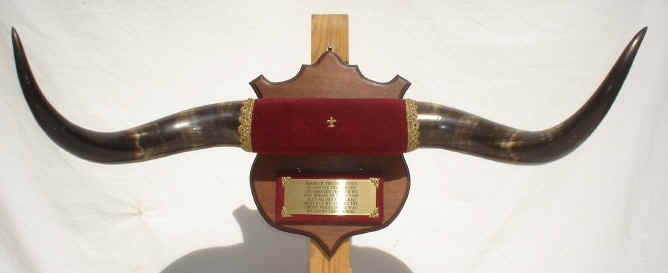
Remounted by Alan Rogers, who added
the engraved plate
that hinges upward to expose the original text. |
Found in Western
Montana in 1987. Said to have belonged to Montana artist, Charles Russell, and supposedly
hung in his studio. He had a reputation and fondness for silk scarves. These horns
came to me in a rough condition and had little remnants of colorful silk cloth still
attached around some of the nail heads. I can't prove, yet, Russell owned these horns.
I have the old
section of wood taken from inside the original mount, which has the following
pencil-written story complete with misspellings, quoted here:
Horns of the
wild steer of Pawnee that killed
Six Shooter Jim and his two horses at Onion
Pass. July 4, 1867. Capured next day by Johney the Gost whos hors was was killed by these
horns.
Fourth of July
celebrations were well-attended
events in the Old West. |
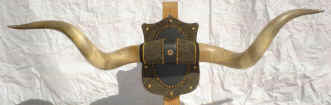
4 ft. 1 inch. Lateral twist.
Found in Colorado.
The term Texas Longhorns was coming into common usage shortly after 1900. From the 1860's,
other terms for Longhorn cattle were Black Cattle; Spanish or Mexican Cattle; Texans or
Texas Cattle; and Mossy Horns.
|
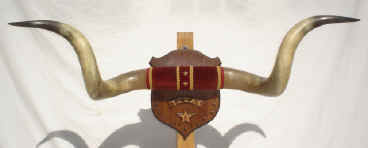
Old steer of 1885-95. From my experience, only about 15% of all old horns ever
mounted were left on a portion of the skull. Nearly always they were removed from
the skull and attached to a block of wood; then covered with some kind of old cloth, buggy
seat material or, sometimes, hide. |
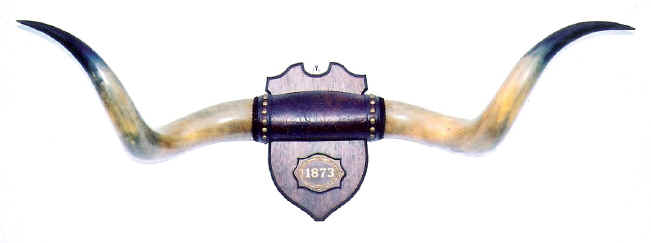
Longhorn Steer Driven Up the Trail in 1873.
1866-95 is the period for the great cattle drives of the American West. This Longhorn
steer was driven up the trail in 1873. This I know as I found parts of old Chicago
newspapers used as stuffing inside the original mount, dated that year. Thousands of Texas
cattle rode the trains to Chicago and were killed there. This steer would have swam the
Red River and passed through Indian Territory, no doubt to a Kansas Cowtown. 1873 saw
nearly 500,000 Texas cattle come up the Trail. It was a wet year. Grass was coarse from
too much rain; streams and rivers were swollen along the way. Later in the trailing
season, bad news would greet the Texas drovers at the end of the Trail because of the
great financial panic of that year, which had developed from overextended bank loans for
railroad construction; and it severely effected the profits of drovers. Principal Kansas
cowtowns in 1873 were Coffeyville, Chetopa, Great Bend, Baxter Springs, Ellsworth and
Wichita. We can never know to which town this steer was driven. There is every reason to
believe he was driven to Kansas and shipped by rail over the Santa Fe or the Kansas
Pacific, and eventually on to Chicago. In the early 1870's a number of teenage steers were
still among the trail herds, and it is very possible this steer was old enough to have
been alive during the Civil War. Old horns dated this early are difficult to find. Large
numbers of horns were not yet being saved or collected in the early 1870's.
The original mount was all square-nail construction. 46 1/2 inches wide.
|
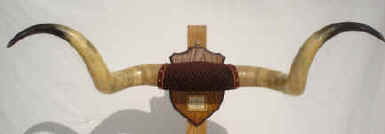
From the Buckhorn, San Antonio, Texas
1930's A forward twist.
Cattle horns are a
protein matter known as keratin, the same substance as our hair and fingernails. |
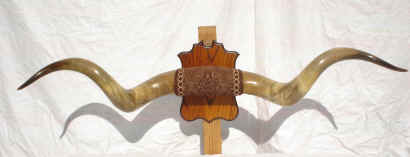
Beautifully Twisted Steer Horns of the
Latter 1880's
Above average with shape. 4 feet.
The corkscrew twist, a common trait once found in early Texas cattle of the purest
bloodline. In the early days of trail drives, the phrase "The Old Fruit" was
commonly used in Texas and referred to anything that was the genuine article. In the
Kansas cattle town of Abilene, where several saloons existed, one proprietor, in order to
attract Texas cowboys to his business, named his saloon The Old Fruit. These are
"The Old Fruit."
|
|
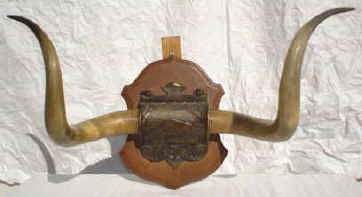
Shipped by rail and killed in Chicago, these 38 inch wide steer horns date to the early
1890's. Cast bronze cover plate by Frederick Kaempfer. These metal cover plates were made
for the mounting of deer, elk, buffalo and steer horns. I've seen a handful of them and
all were cast iron. This is the only cast bronze original mount known to me.
|
|
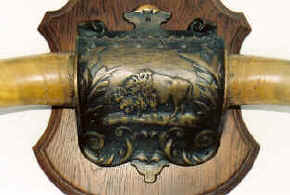
Cast Bronze Cover Plate Closeup View.
Buffalo Design. Dated 1891. |
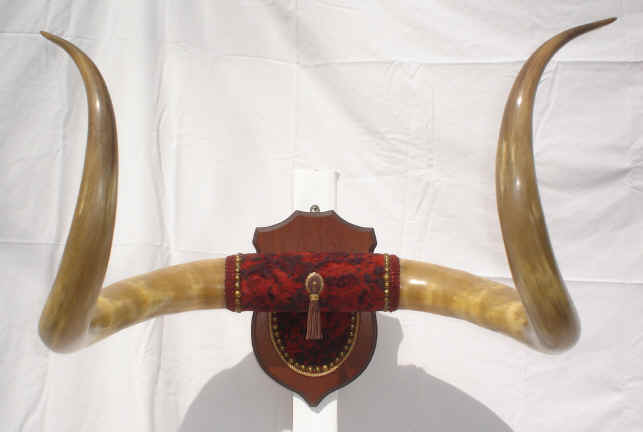
Sometimes a mature steer will produce
so much forward and up growth that very little width is gained.
That's good because it produces the beautiful and unusual shape seen here.
Only 22 inches, tip to tip, but each horn about 35 inches along the surface.
I seldom use the word "rare" but it probably applies here!
|
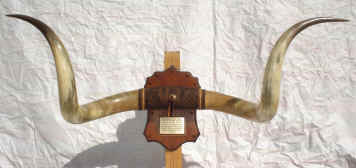
El Tigre (The Tiger) from the Enrique
Guerra Ranch of Old Mexico.
Steer died of old age in 1930, having a generous amount of the forward & up growth
pattern often seen in Longhorn cattle.
47 inches wide.
Backboard includes brass plate with horns' history.
|
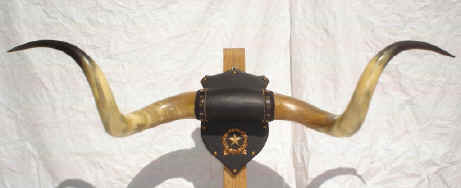
Pre-1900 Horns. Found in New Mexico.
With the classic forward up and out growth pattern. Steers tended to grow the horns most
often collected as they were longer and larger based than cow horns. Better examples of
Longhorn cows were saved also but bull horns, which were generally smaller and had much
less shape, were collected and mounted in much fewer numbers.
|
|
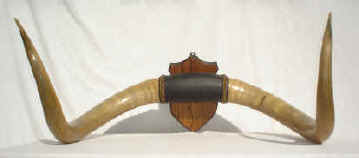
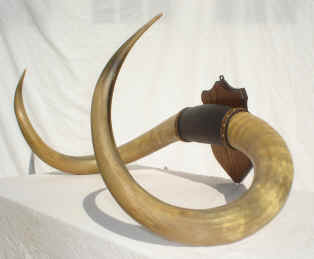
Trophy Class Steer
1895-1910
The forward and up growth pattern common to early Texas cattle. 39 in. around
the curve and 42 inches, tip to tip. Twist & curl gives horns their beauty! Found
in Calistoga, California. The best example of this horn shape I have seen anywhere!
A high-grade set of horns.
|
|
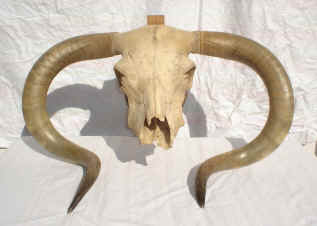
Unusual double-drop horns that would
easily have surpassed six feet had they not grown downward, each horn having about
39 inches of growth. Found in Forney, Texas.
Thought to be 1930's - 1940's. An old steer, well into his teens when he died. Obviously
unable to graze naturally, this steer was most certainly kept and fed in a controlled
manner. Not many quite like him!
|
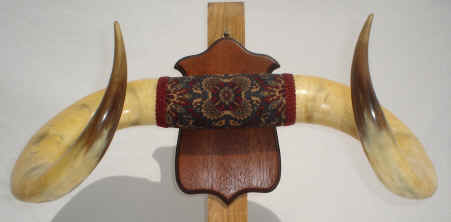
Horns of the 1920's.
Because of their forward and up growth pattern, these type horns often snagged the
underside of other cattle in shipment and could damage hides or cause injuries. From this,
the stockyard slang term "gut hooks" was sometimes used by Yardmen.
|
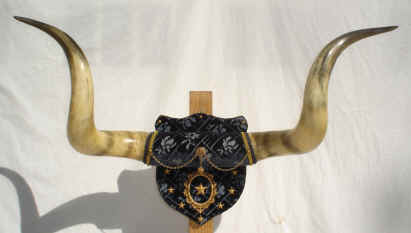
Early steer horns with an example of Alan's restoration.
Fortunes were made from Texas cattle. During the trail driving era, prices varied. As an
example, during this period, Longhorns could be purchased for as little as $6 a head in
Texas and sold for as much as $40 at their final destination. |
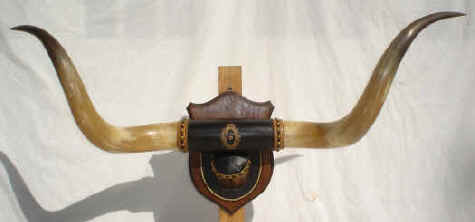 . .
Dark brown tips. Shades of yellow and
browns are common color patterns of old steer horns. This pair, nearly four feet wide,
dates the early 1900's. |
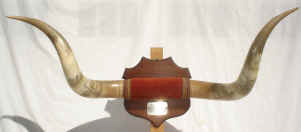
Shipped by rail to the
Kansas City Stockyards in 1914.
A mature steer with a tall growth pattern, about four feet wide.
|
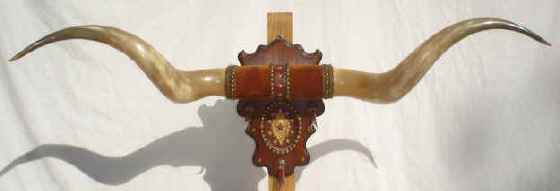
An example of how cattle horns twist and turn forward at the tips. About 1920.
Nearly 4 ft wide.
As many as 25,000 to 35,000
men are thought to have driven between six and ten million head of cattle on the Trail.
While not often mentioned, about one million horses were driven northward. |
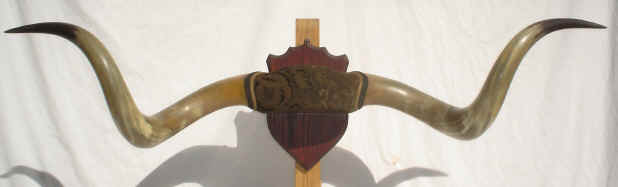
Early Texas Steer
It's fair to place these in the
exceptional class. In my 36 years of collecting, they are in my top five sets.
The abundance of twist and curl comes late in a steer's life. The amount of shape here may
well be of a steer twenty years old.
Originally mounted 1885-95, this steer could have been born around 1870.
4 ft 10 inches wide. The dark green color and coal-black tips are traits found in
early Texas cattle.
I suspect many old-time cowboys lived and died and never saw a set of horns this good.
|
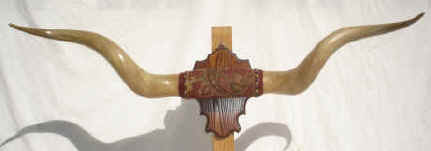
A Corkscrew Twist
Up and out with a little flip at the tip.
A popular shape.
Farmers (or grangers as they were called in
those days) who lived near the cattle trails also profited by selling eggs, butter or
fresh vegetables to cowboys passing by. |
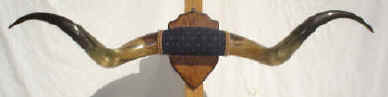
Horns showing an above
average amount
of black at the tips -- about 14 inches.
Well before 1900,
the cattle industry and meat packers had already decided they wanted to do business
without horns. They were harder to ship in railcars, damaged hides and other animals, and
slowed down the killing operation at packing houses. And to those who bought cattle by the
pound, the horns cost as much as the beef. |
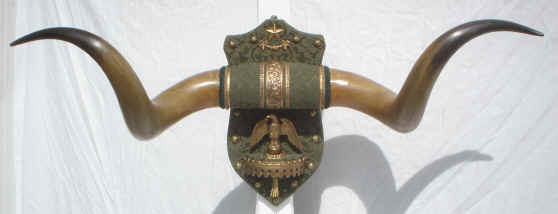
About as perfectly matched as horns will grow!
This steer produced a great deal of shape while only growing to 3 feet wide. This was an
all-square nail mount, an indication the horns will date to the 1870's or maybe a little
earlier. From a steer that may well have been ten years or older.
Studies on
the bones of Longhorn cattle have indicated a greater density of matter than some other
breeds, which is believed to have given Longhorns their ability to be driven great
distances. |
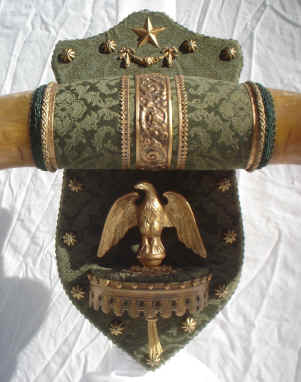
|
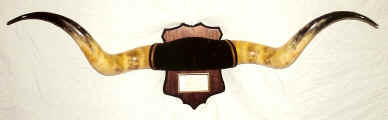
Killed at Armour and Co.
Beautifully colored yellow horns showing much of the woodgrain effect. Shipped
by rail to Kansas City in 1910. In the early days of shipping cattle, an average of
twenty head would fill a cattle car. These horns at 4 ft. 2 ins. made loading difficult.
|
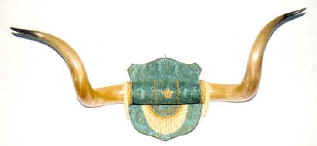
A pretty horn with an Alan Rogers' mount.
It is thought that nearly ten million head of cattle were driven up the trail between
1866-1895. By the mid-1880's, cattle numbers on the trail had been greatly reduced due to
the construction of railroads.
|
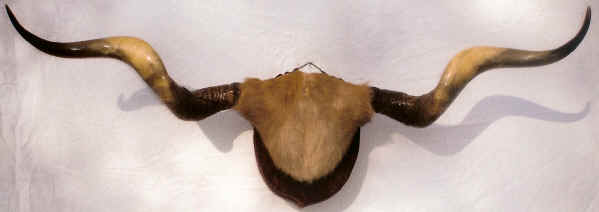
Among the very best horns I've ever owned, and the top set of old cow horns I have seen in
any collection.
She was far above average with her corkscrew twist and may have been well into her
twenties when she died.
Mounted in the 1890's. 38 inches tip to tip.
Longhorn cows very often have their first calf at age 2.
There are documented reports of cows having a calf at age 30.
|
Just as it does today,
Christianity played a role in the Old West. Some cattlemen were more religious than
others. Col. D. H. Snyder of Texas, a Methodist, practiced his religious precepts
everywhere. Taking his beliefs seriously, he rested his trail herds on Sunday. |
Continue to Horn Gallery - Page 2
|